Showing posts with label Ironman. Show all posts

Friday, March 02, 2018

Feb 18: A Look Back

The first two months of the year gone already and the time before my A Race (Ironman Vichy) grows ever shorter. February marked my training's transition from PREP phase into BASE phase. Training proper. 

The weather may be foul, but I cannot let that get in the way of progress. I have continued with a TrainerRoad / Wattbike combination to keep my cycling on the up. I am actually following(ish) one of the TrainerRoad-Base cycling programmes to get me through to the more clement months. 

On the running front, February marked the highest running mileage, for me, in three and a half year. 93 miles. Not a huge mileage for some ... but good for me. This was not the intention but I have been asked to coach a Couch-to-5k lunchtime group where I work. Who am I to say no.

So now, the numbers: -

NUMBER OF SESSION: FEBRUARY(PLANNED V ACTUAL)


MILEAGE TARGET: FEBRUARY(PLANNED V ACTUAL)


One final point to note, is that February also marked an improvement in my 1hr, 1.5hr, and 2hr watt averages on the bike :-)

Now, through the blizzards and into March

Train Strong
Will


Thursday, February 01, 2018

A Bit of Prep

I’m a firm believer that ageing as an athlete should not hold you back. Especially for us that came to sport later in life, just because you have reached a certain age doesn’t mean that all your bests are behind you. Also, in Triathlon, since we compete in age groups – each new age group provides new opportunities for setting AG specific bests. 

For me the challenge of a faster Ironman is still firmly dragging me forever onward, and to this ends I have decided (as alluded to in my last post) to be more structured about my training. 

With a Joe Friel inspired structure, I am just coming to an end of my first phase: PREP. Running from the 1st January through to 4th February, it is a short 5 week phase to get me ready for the real training to get me ready for Ironman Vichy. With this in mind, during Prep of have moved my training to be both more structured and more Triathlon focused (PREP Plan Below). Although, I am still totally ignoring the swim element of the sport.

I have decided to take the TrainerRoad / Wattbike route for the Cycling element of both PREP and BASE phases. The aim: to provide me with structure and focus for the job at hand – rather than just riding round country trails with a few mates. 

I will probably talk more on my thoughts on TrainerRoad / Wattbike in a future post. So watch this space. 

You will also notice from this plan that I have both Saturdays and Sundays as rest days, this is due to the fact that I work away from home - so weekends are family time. Also, this early in the session the planned volume is low enough that I can fit the training into 5 days.

MY PREP PLAN


Next phase: BASE training, so watch this space. 

Will 

Wednesday, January 24, 2018

2018 - A New Start


The start of another year means the start of another campaign… 

But, now in my fifties, I need to consider my long term goals. Is that ever elusive sub 12:30 Ironman doable for me. Or, is it all just a pipe dream that remains forever out of reach? Do I need to revise my goals? Do I need new goals? Questions, questions.


This year I have, once again, entered the ‘hot box’ which is Ironman Vichy (France). I have raced Vichy twice and both times the temperatures have reached the high 30s. (About 100f for those of you who are still old school). Also, the last time the swim was an over distance, non-wetsuit swim. But all considered I like the place, the people, and the race. Plus, I will treat the race as my summer vacation.  
Across the early winter months I have been feverishly scribbling, and now, I have a plan, which consists of:
  • 5 weeks prep 
  • 12 weeks base 
  • 8 weeks build 
  • 8 weeks peek
With the odd ‘off’ week built into the schedule to account for family time and a few breaks to allow for recovery.

So, at the moment, I have the plan, I have the enthusiasm: so I am saying to myself: “Ignore the age and onward and upwards … the goal will be sub 12:30.”

Will

Thursday, September 22, 2016

Fasted Training

Fasted Training is not something I have given much thought to. However, on examining my training log, it is something I do. Regularly. In fact, about 5 times per week. I get up and use my commute to train, run or bike, before having my first meal of the day at work. Or, I get up early on a weekend and grab a quick run or swim before the rest of the household rises – again before breakfast.

So, in short, I am a fasted training.

Don’t get me wrong I am not a low carb high fat dude. Or an evangelist of training the body to burn more fat. It just turns out that 50% of my training is fasted.


The theory:

If you train in a fasted state, the body will be forced to break down stored fats in order to fuel the training. In this situation, your insulin level is low and will not interfere with the fat burning process, thus allowing you to access and burn more stored body fat for fuel.


My Experiences:

Looking back at my training diary I cannot see a definite train. What I can see is that I have had great training sessions, session where I feel like I’m floating along – one with the world. Although, on the flip side, I can also so sessions where I’ve died on my feet. I have bonked, hit the wall – whatever you want to call it.

However, I would say, that I have been more likely to crash and burn in sessions that are closer (in time) to the hour, or more. So, for me – there may be a limit to how much I can push myself on an empty stomach.

But I have been able to maintain quite a low (for me) body fat – even though I like my food and a beer or three.


My thoughts:

Fasted training may not be for everyone. If you think on it. training on an empty stomach used to go against the grain in the fitness world. However, we are learning that there is no one right formula for all who train. So, it may be worth giving a go.

If you do give it a go, don’t jump in all gung-ho. Ease in to things. Test out training at various intensities, as some athletes have better results with easy session but don't perform well with higher-intensity workouts, and yet others are the polar opposite.  

We are all different so it pays to try different training methodologies… don’t you think?

Also, break the fast as soon as you have finished your training. Not with any of these faddy diets., but with a good balanced meal. A meal that includes a good mix of protein, fats and complex carbs …. Your belly will thank you for it.

Will


Friday, August 15, 2014

Making the Most of Time: The Bike Commute (Part 2)

As I have already stated, I have started using my commute to work as active training time. For now, most of this is on the bike. That’s because I’m not very good on a bike. Last time I blogged about my easier structured sessions on the way into work. This time I will cover the harder part of my regular commute.


Travelling from work

On the way home, the need to stay fresh has passed – so I can give these sessions the extra that will push me on. Unless I am actively recovering these will always leave me feeling I have put in some work. (Even at these short distances). There are times where I will just have an easy ride if I need a level of active recovery, but most of the time I try to get some quality work done.

For me I have a 5-mile (or more) stretch up a slight but continuous hill. My most common sessions are: -

  • Saw Tooth Intervals – I pick an upper HR% and a lower HR% and aim to move back and forth between the 2. For example 82% and 65%. I push myself until my HR is at 82% then ease off until it drops back to 65%. Then start to push again. 
  • Heart Rate Time Trial – I will aim to ride home at between 80 and 85% MHR recording the time, to monitor improvement. (This is a bit of a LT training session for me.)
  • Standard Short Intervals – These are simple 1min hard, 1 min active recovery. The 1min hard is hard but not a maximum effort. 
  • High Intensity Intervals – Done as 20sec hard followed by 40sec recover. This time the hard is at my maximum effort
  • Big Gear – A simple one, where I ride the majority of the ride in a much bigger gear than I am use to.
  • Standing – I ride home out of the saddle, thus recruiting slightly different muscles than I normally use.
  • The Long Hill Ride – once per week I will use my road bike rather than my MTB and take a longer route home (25-35mile). The aim of this is to get some quality hill climbing in. I try to hit categorised hills and aim to average well over 100ft of climbing per mile travelled.
Will


Tuesday, August 12, 2014

Making the Most of Time: The Bike Commute (Part 1)

For the majority of us training for Ironman, Triathlon, or any other endurance sport, the key is quite often capitalising on the time that we have available to us. Too often, I hear the excuse: “I haven’t got time to exercise.” We all have the same amount of hours in the day. It is up to us on how we choose to use them.

One way to make more time available is to make use of your commute. I know this is not available to everyone. Some people have mad 50-mile commutes. However, I do know of people that will drive part the way then use the rest of the journey as training time. (There is always a way if you want it.)

For me I am lucky. Where I live has a Sustrans cycle way running through past my house. The same cycle way, further down the line, runs past the business park where I work. Perfect!!!

I no longer drive to work, I run or ride. Bonus training time that does not eat into family time. Result.

For me the journey, depending on my choices, is only about 6-10 miles on the bike. Not a huge distance but it is a distance that I can make work for me. Especially using a heavier fat tiered MTB.


Travelling to work

Obviously going to work, I do not want to arrive there a dripping mess of mud and sweat.  However, I still want the rides to have a purpose (All training sessions should have a purpose). For me my rides into work, none of them hard – but all with a purpose, fit into one of these: -
  • Recovery – Easy spin to loosen up the legs from the rigours of the previous day’s hard work. This will leave me feeling fresh and ready to go
  • Drills – Could be 1-legged drills or focus on individual segments of the revolution. Alternatively, even a combination of the two. Great skills sessions.
  • Constant Cadence – fixing a cadence and completing the whole ride maintain that cadence. Help me learn the feel of various spin speeds.


Next time I’ll look at the harder sessions, on my commute back home.

Will

Monday, August 11, 2014

Getting to the Start Line (Part 2 – The Plan)

I started in my previous article (here) discussing, what I see as, the initial goal of an Ironman race. Getting to the start line. This post will continue with the same theme, but now I will look at the actual need for a plan, rather than the build-up and prep to the plan.

Plan you may say … but do I really need a plan? Cant’ I just Swim a bit, Run a bit and Bike a lot?

Well you could, but that will only take you so far. The project manager in me believe that is you fail to plan, you plan to fail (and all that rubbish)

During the time before you start the actual training for your Ironman, you need to plan for the real training. Moreover, for me, being a bit of a geek, it is yet another joy of triathlon. (I like spreadsheets, schedules, etc.)

The problem is though where to start. Luckily, it does not need to be at the beginning. There are loads of Ironman training plans out there (both free and paid for). They range from 16-weeks long to 24-weeks (or so.) With that, there is also a range that range from beginner to advanced. So something for everyone.

When it comes to these plans, you have a couple of options:

  1. Take them as is and aim to follow to the letter
  2. Adapt them to fit you as a triathlete.


I have seen people have success with both approaches. Nevertheless, for me I need to take the latter course. I find off the peg plans too ridged to fit my lifestyle.  Real life can have the habit of getting in the way. So I study a few plans for the duration and level where I feel I should be training. Then I create my own plan from there,

... Then I forget all about it ...

Well, not really but at times it seems like it. For some weeks there seems to be a gulf between my planned training and my actual. Which just go to show even with careful planning … life can still throw a spanner in the works. However having a plan to work towards, helps provide focus. You will know what you aim to do in a given week. You will know what you training is intended to deliver in a given week. 

You will have the further steps towards that start-line.


Alternatively, you can find a coach and let them do all this for you. Although, that is not somewhere I normally go.

Good luck ... and SEE YOU AT THE START LINE ...

Will

Friday, August 08, 2014

Ironman Austria - My 2015 A Race


This is it my, my main focus for racing next year …


Yep. Ironman Austria in Klagenfurt. I'm not very fast. My best Ironman is 12hrs 56min … but I aim to better this in Austria. Hopefully close to the 12hrs mark.

To stand any chance of this I am aiming to keep up my cycling (and other training) over the winter. I never seem to manage to do this, and my cycle all but dries up. Meaning I start from scratch at the start of the session. Plus, this summer I have focused on getting a hilly ride in at least once to week ... nothing to long 30-40miles but plenty of climbing. I now find hills I used to struggle on, no more than an increase in effort. So fingers crossed.

Onwards and upwards, as they say.

Will


Monday, August 04, 2014

Getting to the Start Line (Part 1 – Before the Plan)

As I stated in a previous article that the first goal, for any long distance athlete (in my opinion), needs to be: .

TO GET TO THE START LINE

When you think about it the pace that an Ironman or other popular long distance event sells out, you are entering a race a year before it is due to take place. There is a lot that can happen to an athlete in a year: -
  • Illness
  • Personal Circumstances
  • Injury
  • Levels of Motivation
  • Priority Changes 

To name a few.

Some things, as an athlete, we have no control over. So we need to look to manage those aspects that we can have influence over.

PROBLEM 1: TOO MUCH TOO SOON

As I have said a year is a long time out. It can be quite often the case that full of excitement over entering a race that we go out there and train every minute we can, beasting every session like we are Rocky. This is not going to help you achieve that first goal of getting to the start line. Far from it.

In short you are on a fast road to, injury, illness, burn out, and motivation crash.

Step back and take things easy. Spend some time exercising and cross training, preparing your body to train in earnest for the event. Most Ironman training programs are 16 to 20 weeks … not 52. Spend the time before you start your 16/20 week programme getting your body into a position where you can follow the programme without it killing you. (Though don’t get me wrong. Any Ironman programme is going to be hard work). 

A side note to maintaining motivation during this period of your year is; to do things you enjoy for some of the time. … But also spend time swimming, running, cycling and strength training, after all that’s what it’s about. 

PROBLEM 2: NOT PREPARING TO TRAIN PROPERLY

For some people 'too much too soon' is as far from their world as it can be. They are the total opposite; and they feel that they will be OK starting a plan 16 weeks out and that will sort it.

No way Jose (as the saying goes)

If you read a few programmes like those offered on sites such as beginnertriathlete.com (or similar) you will see that they recommend that you should be at a point where you are comfortably averaging 10hrs or so of training before you start the programme – What I feel I need to emphasis here is that it is COMFORTABLY AVERAGING not peeking …. So aim to get yourself to the point where 10hrs(ish) is the norm not a high.

PROBLEM 3: NOT TAKING TIME TO RECOVER

Also in your quest to make it to the start line – make sure you take time to recover.

Pushing yourself hard all the time is another short road to doom and disperse. Your body needs time to recover and adapt – to get better – to become stronger. Give it that time. For some that may mean 1 easy week in every 4 (or even 3.) for others ensuring they have 1 or 2 complete rest days each week. Whatever you need take it. You will become a strong Triathlete for it. 

Good luck ... and SEE YOU AT THE START LINE ...

Will


Friday, August 23, 2013

Goal Setting


I have been doing Ironman Triathlon for some time now ... I did my first Ironman (Ironman Germany) back in 2006. I am a slightly overweight, not to fast, middle age bloke that enjoys getting out there and doing it.

  • I am not a natural sportsman.
  • I am not a racing whippet.
  • I do not have unlimited amounts of time to devote to training.

BUT I get round.

In the time I have been competing, I have mentored and helped a few others in similar positions as me through training, to get to the start line of their chosen long distance race, and then to finish line within the cut-off.  So as another campaign looks to get under way, I thought I'd post my thoughts/notes to those I help here.

I must say, I am not a qualified coach preaching the ideal and there are other approaches than mine, but this is AN APPROACH that seems to work in the real world of the complicated lives us ageing age-groupers seem to lead.

GOAL SETTING

My first thoughts are on Goal Setting: 

These days a lot of races sell out almost as soon as they go on sale, so most people start planning at least a year in advance. A year is a long time. You need to have goals that will help you maintain focus across the full year. I am not talking the small more detailed stepping stones here but instead I refer to the big picture goals ... what are your goals for you long distance a race?

Now don't go running of and thing and write on a big piece of card "I will finish in 10hrs 35mins" and stick it to your gym wall. Take a step back and breathe. Goals for your first Ironman (and possibly for subsequent long distance races) should be along the lines of ...
  • Make it to the start line.
  • Finish within the cut off(s).
  • Finish in a time of xx:xx
and maybe even
  • Qualify in age group
And your goals should be approached in that order of priority. The most important thing is getting to the start line. 12 months is a long time and may things can and WILL go wrong.
  • Lack of motivation
  • Injury
  • Illness
  • etc
Next you need to focus on getting round in the cut-off time. This is not just the overall cut-off, which can range from 15-17hrs depending upon the race, but any other intermediate cut-offs, such as ...
  • Out of Swim
  • Midpoint bike
  • Off the bike an onto run
  • etc
Only  when you commit to these first two goals fully can you then start to have dreams on faster times.

Next time, Goal 1: Getting to the start line.


Monday, September 03, 2012

August 2012


August was all about get some consistency into my training. When I look back at my preparation for the Outlaw Triathlon was dismal to say the least. I think I only averaged 3 training sessions per week, and even though they were long sessions that is not enough for Iron distance triathlon.

I trained on 20 days in August and more than half of them were double days, i.e. 2 training morning (or lunch time) and evening. So in total I managed to rack up 31 training session, an average of 1 per day.

Currently I class this part of the year as being ‘Off Season’ so include generic strength training (Weights) and other cardio work (not S/B/R) so my overall mix is slightly different than if I w as to be following a specific training program. 

The following graph shows how each week in August was made up...


In all I trained almost 48hrs in August's 5 weeks, of  which averages 1.44 hours per day and over 10hrs a week. This gives me a good staring point as I would like to be averaging closer to 12hr per week if possible in this off season.

The second graph looks at the month as a whole, split and grouped by the major elements... 


Finally the week in numbers

BIKE 14h 53m 248Mi
RUN 12h 18m 66.7Mi
SWIM 4h 14m 9600m
STRENGTH 6hr 05m
OTHER CV 3hr 26m

WW

Friday, August 17, 2012

Outlaw 2012

An alternate set of images from the Outlaw 2012 iron distance triathlon ...


Well done to the 843 athletes/teams who finished


How old were the finishes?

How fast were the age groups?

What were their splits like?

What was Mr/Mrs Average's race like?

Did the outlaws who finished get there bike/run right?

How many finished in each hour>


WW

Monday, July 23, 2012

Something to Aim For


I am the sort of person that needs a focus, a goal, in order to achieve any sort of consistency in training. Even then it’s not guaranteed. But without it; I would find myself skipping out on training for allsorts of reasons, that all seam valid excuses at the time.

So I have picked my ‘A’ race for next year. I will be competing in Ironman Switzerland in Zurich. This race takes place on the 28th July 2013, so I have plenty time to get in shape. The timing of this sits nicely with my overall ‘Faster/ Fitter / Stronger’ challenge so hopefully I will go into the race in my best shape ever.


I have done this race before back in 2009 when I had lots of problems with my back … so I have a score to settle, with the bike course on particular.

So, as they say, ‘onwards and upwards’

WW 

Monday, May 09, 2011

A look back on April

A bit late with this post, but I have been a bit busy sorting the move to a new contract position which I start next week. 

April turned out not to be as good as I planned, the aim was to up my cycling, do at least on cycling hill rep session per week and to stay consistent … that all went to the wall half way through the month when something in the right side of my back when twang during a hill rep session.

I was just finishing an 8 x 5min seated hill set and a felt a sharp pain, but it seem to ease so I finished off with a few sprints and then an hours run. The next morning I swam an it felt sore but OK and I went for e recovery MTB ride, but the first time I stood to apply pressure to the peddles for a sharp clime .. back came the pain but a lot more intense.
I ended up having to visit the physio for 2 x deep tissue massage session, 2 lots of acupuncture and 1 lot of manipulation ... plus my training was restricted to slow easy run/walks and swims …although a couple of dips in the icy North sea seamed to help a lot.

The month came in at Just under 44hr, way off target

The splits for my training


Training month on month


My aim for May is to get back into it, and finally get in some proper cycling!

Tuesday, April 19, 2011

Let there be BRICK!

Last night i did one of the many Brick sessions that are in my trainng plan

Brick training session are sessions where you train for two of the disciplines back-to-back, traditionally a brick session is BIKE then RUN but can also be SWIM then BIKE or any other combination that you can think of, (but some people mat call them something else).

They all have there place in training some more than others, generically any training session made up of two discipline will help your body prepare for doing more than one thing in a race, so transitions from one discipline to another will not be a big shock to the system, as Triathlon is a sport in itself and not just a sum of its parts. Plus it is also a way of helping you get all those required sessions fitted into a weeks training

Swim to Run training is normally done as part of open water training (on my part) where I will have a long OW swim followed by a short tempo run to loosed up afterwards, this type of training can also be useful for Aquathalons.

Running then cycling, this is mores specific for those that take part in duathlons that are often Run-Bike-run

Swimming then Cycling gives us the chance to practice T1 (which can take some time), getting out of our wetsuit and off onto the bike, many people have problems with dizziness and nausea when moving from the prone position of the swim to the upright position and if you are like this, this is a very useful session

Cycling then running, this session is the most popular although (IMO) a lot of training plans do not introduce them early enough. Firstly the prepare you for the ‘jelly leg’ felling of moving from Bike to run, next they help you more quickly improve your generic endurance as Bike-run brick session can be longer earlier in the season as doing two different disciplines does not place the same stress on the body as would just a long bike or long run and I would do one of these Brick sessions most weeks These bricks and can be approached different ways

A steady/easy bike followed by steady/easy run, used to help build overall endurance and train the body for the transition

A hard structured bike followed by steady/easy run, this is a bike focussed brick session that will leave our legs feeling like they belong to someone else when you start the run, great fun, and great preparation due to the fact that you will be most likely giving it all on you bike before you start you run in a race

A steady/easy bike followed by hard (and/or) structured run, this one is run focussed and helps the body to adapt to getting up to speed on the run as quick as possible.

A hard Bike followed by a hard run, is simply what it say s on the tin and is race specific and lets you try out back to back in race simulated conditions, but (for me) this would probably normally be a shorter session so not to risk injury.

Bricks do not have to be the same every time, be creative and mix them up, for me last nite was a Bike focused brick and took the form of: -

BIKE (2:10 total)
  • 20-30mins warm up, mixed HR
  • 8 x 5 min seated climbs at VO2max
  • 8 x 1 min hill sprints, flat out
  • Mixed cadence work to finish
RUN
  • 1 hour trail run
So get out there and brick

WW

Monday, April 11, 2011

Doubts and Fears

From time to time as you work towards your Ironman goal, you mind will start working overtime and allsorts of doubts and fears will creep in, trying to derail you a knock you off stride, these doubt and fears can take many forms :-

  • What if I’m not training enough?
  • Am I training too much?
  • I’m carrying to much weight
  • I swim like a drowning rat?
  • Joe Blogs seems to be so much further on than me
  • I’m to slow on XXX discipline
  • Etc etc …
Well for me these doubt and fears are always focussed around one main area, yes I know I didn’t do even half the training I should have last year, but my doubt and fears are always focused around the BIKE.

I am a week cyclists and see it as my biggest limiter, I am poor on the climbs, I am slow, my knees ache, my back struggles with the time I’m on the bike and my muscles pump out to quickly and so on…

But when I look at it rationally, I am training and following a plan, my plan includes endurance, strength and skills elements, I have spent the off season focussing on improving my core and generic strength. So I know I am doing what is required of me to improve and there for I should not worry, I know my training plan is balanced in away to give enough focus to this weakness but not overly sacrifice my training else where.

But I do, I still worry: -

  • I’m to slow on the bike
  • I’m going to show myself up on the hill climbs
  • I’m not spending enough time in the saddle

But I need to squash these fears and doubts, focus on the positives and take strength and resolve in what I know I am doing.

So if you too, suffer doubt and fears on you path towards Ironman, take heart in the knowledge you are not alone.

Onwards and upwards

WW

Tuesday, April 05, 2011

A look back on March

March for me was always intended to be a breakthrough month, it was to have a focus on pushing myself and moving my training on to the level I believe is needed for me to better my Ironman PB time.

To do this I set myself the challenge of training every day of the month, I know that there is a need for rest and recovery, I know that this is not something that can be maintained due to the risk of overtraining an injury, BUT it can be done for a month, after all I have a desk job and spend most of the time sat down and I aimed to utilise active recovery instead of rest, such as sub 2k swims etc.

In total I managed to train almost 55hours in March

I thought training every day would see the weight fall off me but I actually put on 2lbs … I get hungry when I train a lot .. but I did see my body fat drop significantly to 17.5% the lowest since Ironman Germany 2006

March also saw a number of other personal barriers pushed through for me …

  • I manage to break 300pts in the training point league for the first time ever beating my form PB by about 60pts
  • I also did my longest swim since 2006 … 7000m

So all-in-all a good month onward and upward

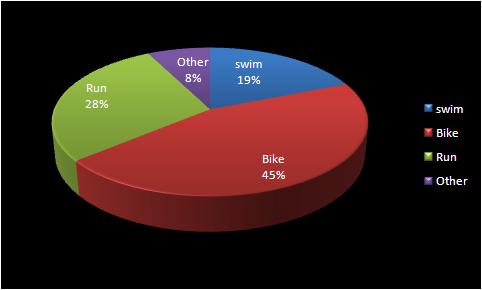
The following pie chat shows how my training was split for the month


This graph shows my monthly training my time (hours) with a significant jump in March


WW

Monday, March 28, 2011

Goals & Objectives

… and activities

Firstly a bit on what I am talking about, a GOAL is a broad statement of what we want to accomplish, in my world this year my GOAL is to race an Ironman PB in Regensburg in Germany this summer and finish before the clock turns 13hours.

To get there I am setting a number of interim OBJECTIVES to achieve this GOAL (which I will come onto in a moment)

ACTIVITIES are the actual things I do in working towards the OBJECTIVES, but it also needs to be noted that OBJECTIVES are not just a bunch of ACTIVITIES, they actually need to challenge in a way that they will help achieve the overall GOAL.

So far I have had a couple interim OBJECTIVES each one month in duration …

THE FIRST was to loose weight, I was weighing in at over 210lbwhich is to heavy for me, so my first objective was to loose weigh, to get back to around 200lb and into a ‘teen’ body fat, this will aid my overall objective by being lighter and in better condition when I race, lighter for the hill climbs and hopefully faster on the bike, Activities for this task involved keeping a food diary, replacing various foods for healthier alternative and training in a way to aid fat loss but maintain muscle

THE SECOND and current, is to improve my consistency in training, and although this is contentious I decided to aim to train every day this month, to use active recovery instead of rest, ensure I slept correctly, maintain a health diet and monitor key indicators of training/overtraining within my body. In the past I have often been guilty of not being consistent enough in training and therefore this kick up the backside will help deliver a more solid base to this years training and therefore i'll be in a better place when i start the build.

NEXT month the objective will be run based, as my Ironman Marathons in the past have always been well below my actual marathon capabilities and I am looking to fix that, I am not sure on the nature of the objective(s) yet, but watch this space

To achieve the GOAL, we need both resolute and flexible. When difficulties and unexpected problems present we need to HTFU and JFDI (see post)and stick to our goals. But always stay flexible with your objectives and activities. If the way you do things now does not work, try another way. Keep trying until you find the one that works.

This approach is probably not for everyone …but I am giving it a go

WW

Thursday, March 24, 2011

HTFU & JFDI

This post is based on a thread that I kicked off on one of the forums that I frequent and a thread that resulted in a wide range of feedback.

My point is that we (including me) are all guilty of taking the easy path, and ditching the odd session, when we have a head cold, feeling a bit weary, jaded after a hard day at work. We loose sight of our ultimate goal we look for acknowledgement of our wish to drop a session by posting on forums or face book in the hope that someone comes along and says…

“It’s ok have the day off training. It'll do no harm”

But quite often it’s not ok, it can become a pattern in our training, missing session during base training it can weaken the foundation that we are seeking to build on, missing sessions in later phases could mean that we are not as fast, strong or as sharp as we could have been. 

This is Ironman and it’s not meant to be easy!

Yes if you in bed ill with flu then don’t even think about training if you have gone beyond being tired and are truly on the verge of over training then you body will need to be rested but feeling a bit tired from time to time can be expected, afterall this is Ironman Training, the mental exhaustion from a hard day of work can often be replaced with a feeling of contentment when we get out there and train.

Where our forefathers had highly physical jobs down mines and in shipyards, we largely have it easy with a large proportion of the modern workforce working in offices and similar, we are not as physically exhausted at the end of the day as we think … it is indeed a mental exhaustion that we feel  and misinterpret, get your kit on and get out there, give it a try, ease into it … if then you cant rise to it’ call it a day on the session at least you did HTFU &JFDI afte all a lot if ironman training needs to be in Zones 1 & 2 anyway

As I have said there are often times when we HAVE to miss a session but what I am saying is learn the differences between HAVE and WANT

WW


Friday, March 04, 2011

Run, Run/Walk, Walk

Whichever way you look at it the Ironman marathon is both a challenge and a joy, you will have the swim and the bike behind you and you will be thinking more of the finish line but you will also be hurting, you will be tired and aching and you insides may be doing summersaults (think portaloos).

Unless you are a one of the very speedy types walking will probably pay part of your race. You will see many posts on various forums from those macho types belittling those who walk, but in truth many find themselves walking at sometime during the marathon.

You may have a strategy of run 9 walk 1 or similar or walk the aid stations and ramps and run the rest or you may just be playing it by ear.  In Switzerland I ran the first lap quite fast, then i switched to 9/1 and by the end it was more like 2/1 but I got round in a reasonable time.

The key to this is (IMHO) to know that walking in a race is not a stroll, you need to know how to pace you walk, In my first Ironman in Germany 2006 I walked most the marathon as I'd overcooked it on the bike, but I was passing others who were running and i finished strong. if you think about it, if you walk at 7kph you can cover a marathon in close to 6hrs

A good place to practice pace walking is on a treadmill, maybe as part as an indoor brick session, a typical session may look like ...
  • Spinning class
  • Then Treadmill set the incline to somewhere between 1% and 5% and start at 5kph
  • Each minute up the pace  by  0.5 kph until you are at 7kph 
  • then alternate 5min intervals at 7.0kph and 7.5kph for up to 1hour


The purpose of 7.5kph interval is to make the target pace of 7kph feel 'easier'

Also when you're out and about think walk not stroll

All this will hopefully help you not slow down too much in your Ironman marathon when you walk ... remember WALK DON'T STROLL 

WW